Buy this one if you want a good latte without learning anything. It weighs the dose, tamps the puck and froths the milk on a preset, so the drink is right in week one. It also brews drip coffee and cold brew, which the Express doesn’t.
The all-in-one that does the barista’s job for you: it weighs the dose, tamps the puck and froths the milk, and it brews drip coffee and cold brew too.
Buy this one if you want to learn to make espresso. You grind, dose, tamp and texture the milk yourself, on a machine with a decade of owner guides and a standard 54mm portafilter. It asks a month of practice and pays it back in skill.
The all-in-one that teaches you espresso: you set the grind, judge the dose, tamp and steam by hand, and after a month you can make a latte on any machine.
Whisk plus steam, 4 presets incl. cold foam, or manual
Manual steam wand
Shots
Shots
Double or quad
Single or double
Other drinks
Other drinks
✓Drip coffee (6–18oz) and cold brew
Espresso only
Portafilter
Portafilter
Size not stated
✓54mm stainless, single and dual-wall baskets
Water tank / beans
Water tank / beans
Not stated
67oz tank, half-pound hopper
On the market
On the market
Since 2024
✓Over a decade
The Ninja wins on automation and the Express on openness and track record. Which rows matter depends on whether you want to make espresso or just drink it.
The difference that actually matters
Both machines put a conical burr grinder and an espresso machine in one body, and both will pull a good shot from fresh beans. Where they part is who does the work between the beans and the cup.
On the Express, you do. You pick a grind, the grinder runs for a set time, and you check the dose by eye. Then you tamp by hand, trim with the dose tool, and steam the milk with a manual wand. Every one of those steps can go wrong, and every one is a skill you will have for good once you have it. That is why the Express has been the default first machine for over a decade: it is a course in espresso with a grinder attached.
The Luxe Café takes those steps away. It weighs the dose rather than timing it, so new beans don’t quietly change how much coffee goes in the basket. The assisted tamper presses the puck level, and a whisk paired with the steam wand textures the milk while you walk off. The drink is right on day one, and you learn very little making it. For most people buying their first espresso machine that is the better trade, because the goal is the latte, not the lesson.
The Ninja also brews drip coffee and cold brew. In a house where one person drinks lattes and another drinks a mug of coffee, that turns it from an espresso machine into the only coffee maker on the counter.
Luxe Caféwins if…
You want a good latte this week, not after a month of practice
Several people will use it and none of them want to dial in
Someone in the house drinks drip coffee or cold brew
You want cold foam and iced drinks without extra gear
You’d rather the machine weighed and tamped than you
Barista Expresswins if…
You want to learn espresso and enjoy getting better at it
Latte art is the goal: a manual wand is how you get there
You want standard 54mm baskets, tampers and distribution tools
You value a long track record and a huge library of guides
Espresso is the only coffee anyone in the house drinks
Luxe Café Premier or Pro?
Ninja sells the Luxe Café in two main versions. The Premier, compared here, is the one most people buy. The Pro uses the same grinder and brew system and adds a separate hot-water spout, a tamper you pull with a lever, a single-shot basket and a larger milk jug, for more money. Buy the Pro only if you make Americanos or tea every day.
If you want the Express without the waiting
The Barista Pro is the Express with three-second ThermoJet heat-up and no pause between shot and steam, still with a manual wand. Both are ranked in the best espresso machines under $1,000, alongside the Luxe Café.
Every all-in-one espresso machine puts the grinder in the box. The Luxe Café also takes over the three jobs that make a beginner’s first month miserable. The conical burr grinder has 25 settings and weighs the dose rather than timing it, so a change of beans doesn’t quietly change how much coffee is in the basket. An assisted tamper presses the puck level without you having to judge the force. A spinning whisk paired with the steam wand textures the milk on four presets, from steamed milk to cold foam, and you can walk away while it does. Ninja’s listing also says the machine adjusts temperature and pressure for the drink you select. On top of that it brews a drip-style coffee in six to eighteen ounces and cold brew, so the person in the house who doesn’t drink espresso uses it too. What it doesn’t do is teach you espresso: the machine makes the decisions, which is the point if you want a latte at 7am.
Pros
Weight-based dosing straight from a 25-setting conical burr grinder
Assisted tamper presses the puck for you
Hands-free frothing: whisk plus steam, four presets including cold foam
Drip coffee and cold brew as well as espresso
Onboard storage for the tamper, baskets and cleaning kit
Cons
Little to learn from: the machine makes the dialing-in decisions
Ninja doesn’t state the portafilter size, so third-party baskets and tampers are a gamble
Much less owner history than the Breville Barista machines
The Pro version’s hot-water spout and lever tamper aren’t on this model
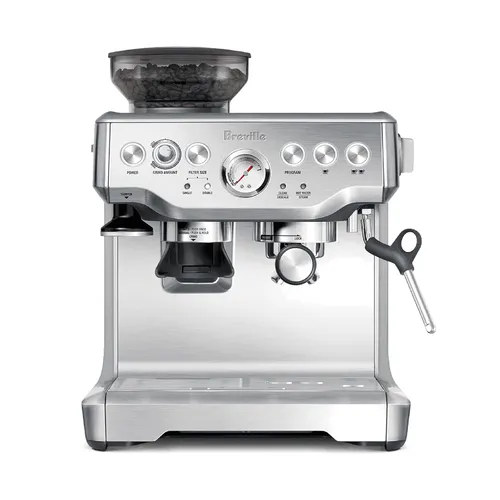
The Barista Express is the most popular home espresso machine in the world for a reason. It has a built-in conical burr grinder, so you go from whole beans to espresso in a single machine — no separate grinder cluttering your counter. The grind-to-brew workflow keeps everything tight: adjust grind size, dose, tamp, pull. You learn espresso fundamentals without needing extra equipment. The steam wand is manual, which means you'll need to practice milk texturing, but that's actually a plus — you're building real skills. It's bigger than the Bambino, but you're getting a grinder and espresso machine in one footprint.
Pros
Built-in burr grinder — no separate grinder needed
Grind size dial makes adjustments easy to see and repeat
PID temperature control for consistent extraction
Manual steam wand lets you learn real milk texturing
Huge community — tons of tutorials and tips online
Cons
Built-in grinder isn't as good as a dedicated espresso grinder
Bigger footprint — needs more counter space
More to learn vs. the Bambino Plus's simpler workflow
Higher price point at around $685
Common questions
Which is better, the Ninja Luxe Café or the Breville Barista Express?
For most people buying a first espresso machine, the Ninja Luxe Café. It weighs the dose, tamps the puck and froths the milk on a preset, which removes the three steps where beginners fail on the Barista Express, and it brews drip coffee and cold brew as well. The Barista Express is better if you want to learn espresso: you control the grind, dose, tamp and steam, it takes a standard 54mm portafilter, and it has a decade of owner guides behind it.
What’s the difference between the Ninja Luxe Café and the Breville Barista Express?
Both have a built-in conical burr grinder. The Barista Express times its dose and leaves tamping and milk to you, using a manual steam wand. The Ninja Luxe Café weighs its dose, has an assisted tamper and froths milk hands-free with a whisk and steam on four presets, including cold foam. The Luxe Café also brews drip coffee from 6 to 18oz and cold brew. The Express has a 54mm portafilter, PID temperature control and low-pressure pre-infusion; Ninja doesn’t state its portafilter size.
Is the Ninja Luxe Café easier to use than the Breville Barista Express?
Yes, by design. On the Barista Express you judge the dose by eye, tamp by hand and learn to steam milk with a manual wand, which takes most people a few weeks. The Ninja Luxe Café weighs the dose, presses the puck with an assisted tamper and textures the milk itself, so a first-time user gets a drinkable latte on day one.
Is the Ninja Luxe Café worth it over the Breville Barista Express?
It is if you want milk drinks without a learning curve, or if someone in the house drinks drip coffee: the Luxe Café replaces a coffee maker as well as an espresso machine. If you want to learn espresso properly, or plan to add third-party baskets and tampers, the Barista Express is the better buy, because its 54mm portafilter fits a whole market of accessories.
Can the Breville Barista Express or the Ninja Luxe Café make drip coffee?
Only the Ninja Luxe Café. It brews a drip-style coffee in sizes from 6 to 18oz, plus cold brew and a cold-pressed espresso for iced drinks. The Barista Express makes espresso only; the closest you get is an Americano, espresso topped up with hot water.
Does the Ninja Luxe Café Pro change the comparison with the Breville Barista Express?
No. The Luxe Café Premier and Pro share the grinder, weighed dosing and brew system. The Pro adds a separate hot-water spout, a lever tamper, a single-shot basket and a bigger milk jug. Against the Express, the Premier is the one to compare, and the Pro is worth it only if you want hot water on tap for Americanos or tea.