GuidesBrowseComparisons
Roundup

Best Coffee Grinders Under $100

Grounds that come out one size are the upgrade a morning cup notices most. Six burr grinders under $100, by hand and electric, and what’s worth buying under $50.

By Dana WhitfieldUpdated November 2026
6 products compared8 min read
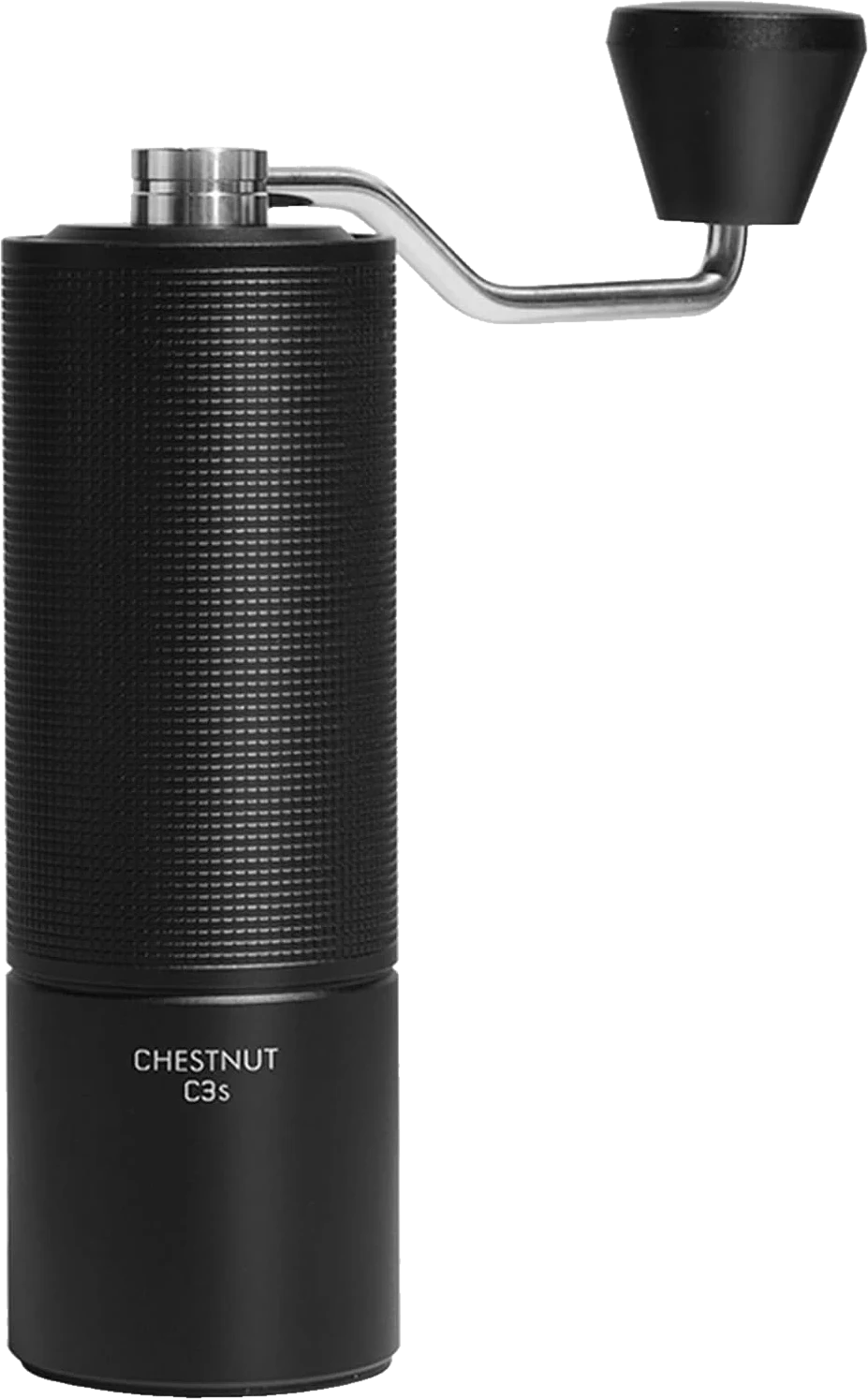
Timemore Chestnut C3S

★ Our top pick

Timemore Chestnut C3S

Best Grind Under $100 · Around $65

For a cup or two by hand: an S2C burr that keeps dust out of the cup and a bearing that keeps the handle turning.

OXO Brew Conical Burr Grinder

Best Set-and-Forget

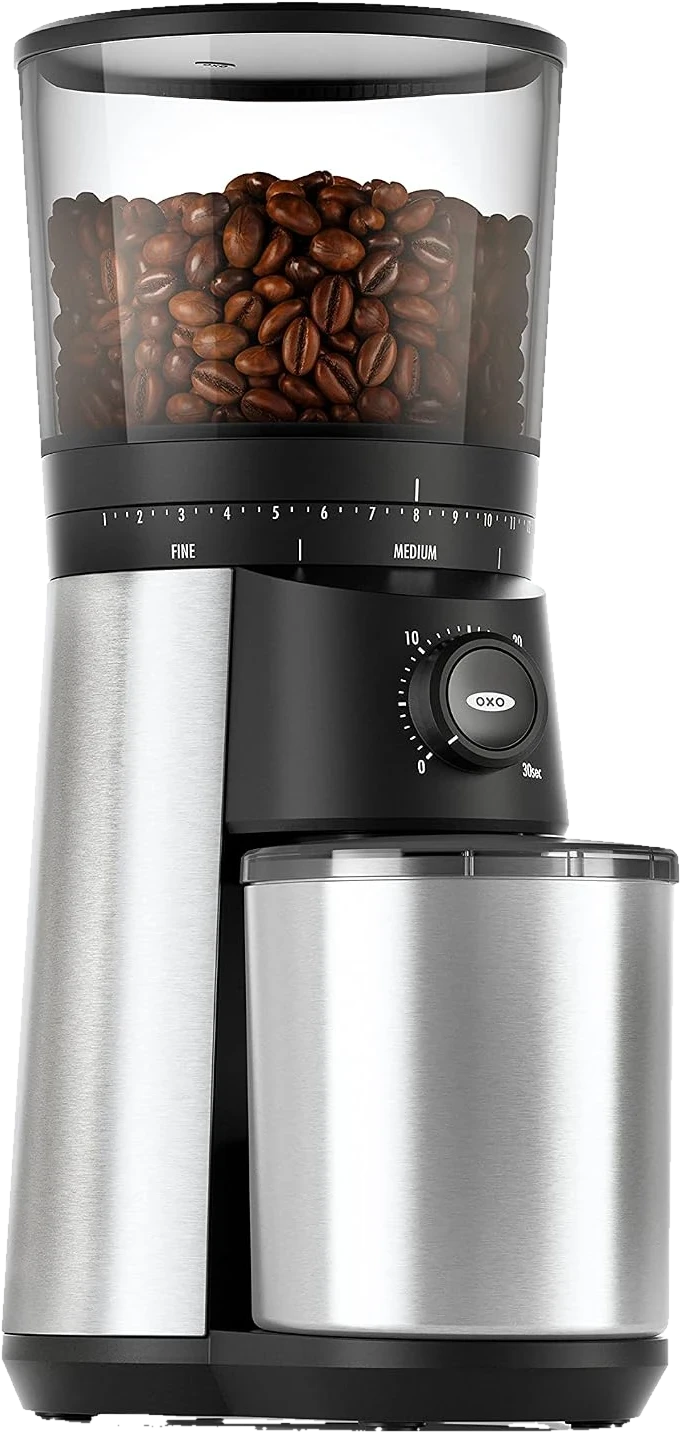
OXO Brew Conical Burr Grinder

Around $80

Set the grind once and every morning is one press: it remembers your setting and holds 12 oz of beans.

Cuisinart Supreme Grind Automatic Burr Mill

Best Ultra-Budget

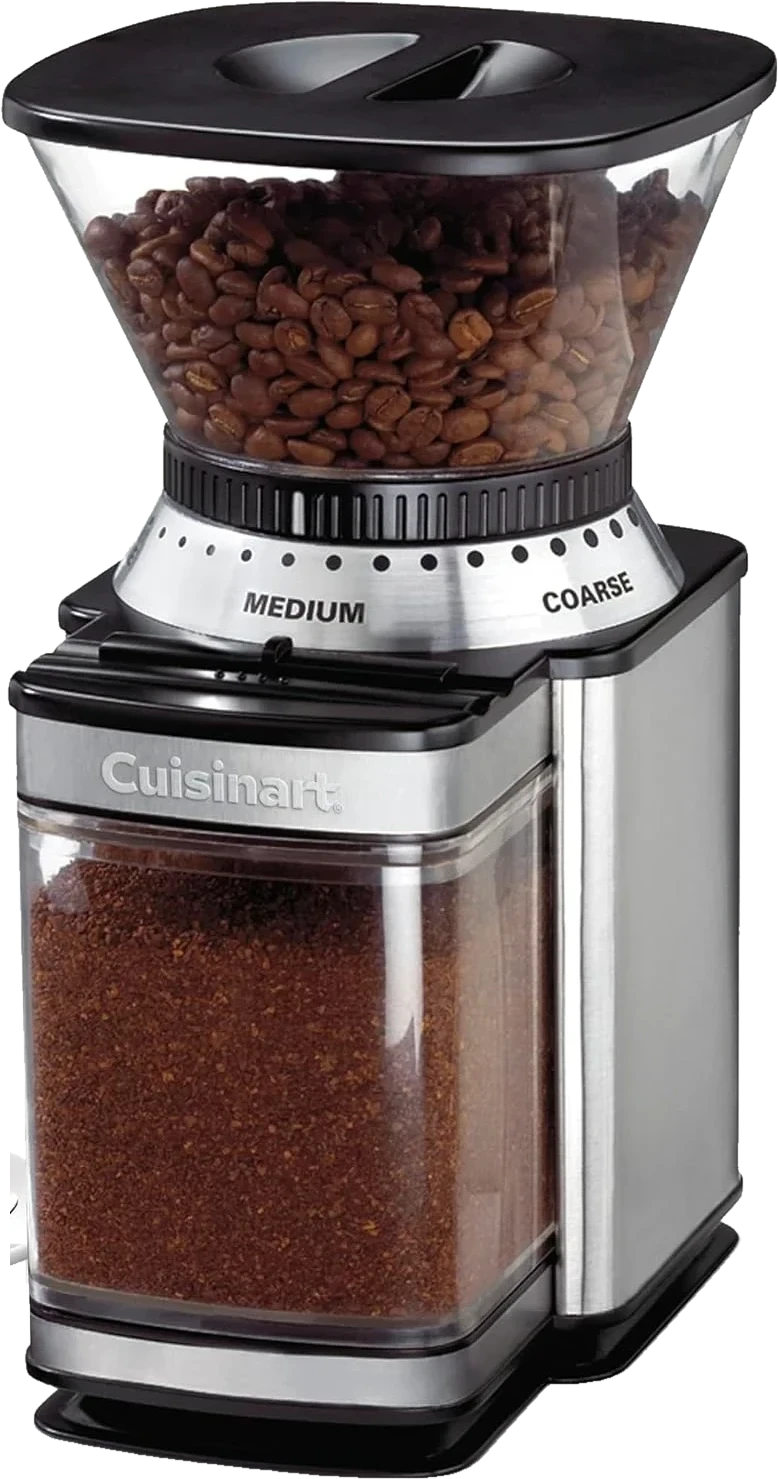
Cuisinart Supreme Grind Automatic Burr Mill

Around $75

The burr grinder to replace a blade grinder with. 18 grind positions and dead-simple operation for under $75.

Under $100 buys the change a morning cup notices most: beans ground to one size a minute before you brew. Swap a blade grinder or a bag of pre-ground for any grinder here and the same coffee comes out sweeter and rounder, without the bitter, hollow edge of stale or uneven grounds.

At this price the choice is your arm or a motor. A hand grinder spends nearly all of its price on the burr and the shaft that holds it steady, so for one or two cups it gives the more even grind. An electric spends a share of the same money on a motor and a hopper, and in return it grinds a full pot while you fill the water tank.

So the picks are split that way: hand grinders for a cup or two, electrics for a pot. Every one has real burrs; blade grinders didn’t make it. Brewing a pot every morning and able to stretch the budget? Our grinders for drip coffee guide starts with the step up.

By hand, for a cup or two

One filter dose is thirty to sixty seconds of turning, and both go from pour over to French press.

Best Grind Under $100
Burrs
Conical
Settings
About 36
Espresso
Filter only

Why we love it

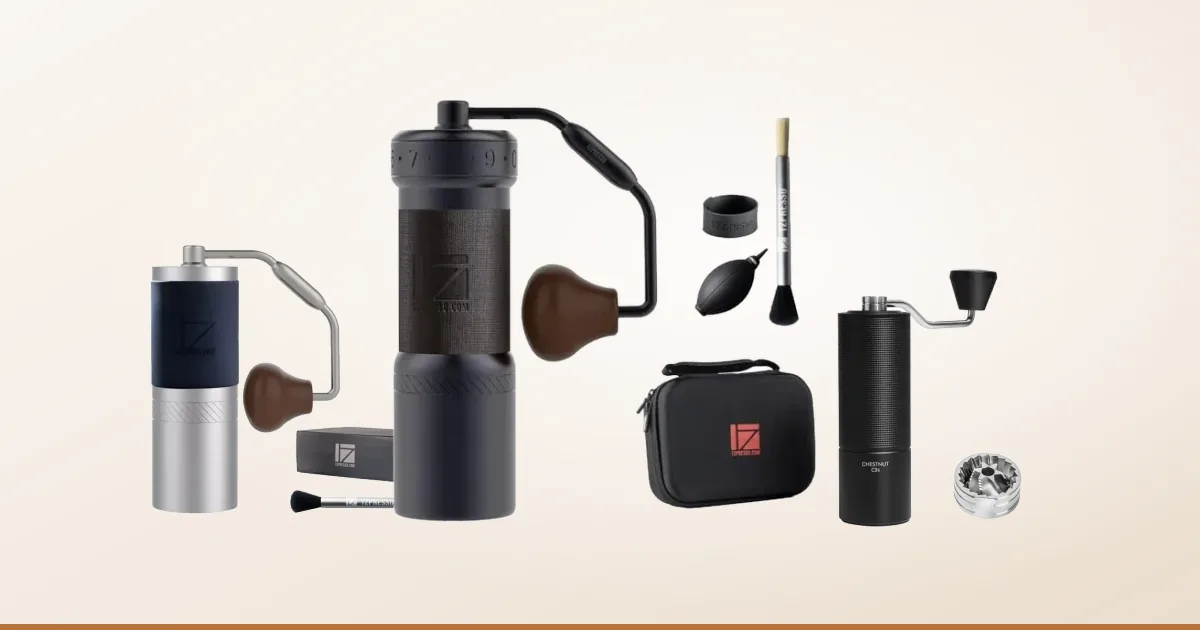
The hand grinder most people should start with. The S2C burr produces noticeably less dust than the cheap stainless burrs it competes with, which is what you taste as muddiness in a pour over, and a built-in bearing means the handle keeps spinning after you let go rather than fighting you. The body is metal rather than plastic and the handle folds, so it survives a bag.

Pros

  • S2C conical burr generates far less fines than budget burrs
  • Bearing-assisted movement — noticeably easier to turn
  • All-aluminum body, no plastic shell to crack
  • Roughly 36 adjustment steps from fine to coarse
  • Folding handle, genuinely packable

Cons

  • Adjustment is by nut with no numbers, so settings are hard to return to
  • Fine enough for espresso is a stretch — this is a filter grinder
  • Grinding a full pot by hand takes real effort
  • Slim body is harder to hold steady than a fatter grinder
Nests in an AeroPress
1Zpresso Q Air

1Zpresso

1Zpresso Q Air

8.4/ 10
Burrs
Conical
Settings
30 clicks a turn
Espresso
Filter only
Holds
15–20 g

Why we love it

Built around one idea: it nests inside an AeroPress plunger. That makes it the grinder for a hotel room, a desk drawer or a rucksack, and it doesn't cut the thing that matters to get there — the burr is a real stainless conical and the adjustment is numbered clicks, so you can write down a setting and come back to it. Capacity is one brew, which is the honest trade for the size.

Pros

  • Nests inside an AeroPress plunger — a genuine travel kit
  • Numbered clicks, so a setting is repeatable
  • 30 clicks per rotation is fine enough control for filter
  • Cheapest 1Zpresso, and the burr is not where they saved
  • Factory-calibrated burr, one-year warranty

Cons

  • Holds one brew's worth of beans, 15 to 20 g
  • Not intended for espresso
  • Small body and short crank mean more effort per turn than a full-size hand grinder
  • Slower per gram than the bigger 1Zpresso grinders

Electric, for a full pot

Each doses a pot for you, by timer, cup count or one button, where by hand a pot is minutes of turning before work.

Best Set-and-Forget
Burrs
40 mm conical
Settings
15 + micro-steps
Espresso
Filter only
Holds
12 oz

Why we love it

If you want a set-it-and-forget-it grinder that just works, the OXO Brew is hard to beat. The reason is the one-touch timer remembers your last setting, so every morning you just press the button and walk away. The 15 grind settings plus micro-adjustments cover everything from medium-fine for drip to coarse for French press (it technically has an espresso setting, but dedicated espresso grinders will outperform it there). The UV-blocking hopper is a nice touch — it protects beans from light degradation in sunny kitchens. The stainless steel grounds container fights static, so you won't have grounds clinging to everything. At around $80, it's the best grinder for someone who wants consistent, hassle-free grinding without thinking about it too much.

Pros

  • One-touch timer remembers your last setting — just press and go
  • UV-blocking hopper protects beans from light
  • Static-fighting stainless steel grounds container
  • 12oz hopper capacity for the whole week's beans

Cons

  • Not precise enough for serious espresso dialing-in
  • 15 settings is limited compared to 40+ setting grinders
  • Some owners report it breaking down within months
  • Hopper-fed design means beans sit exposed between uses
Slow, Quiet Burrs
Burrs
Conical
Settings
16
Espresso
Yes
Holds
11 oz

Why we love it

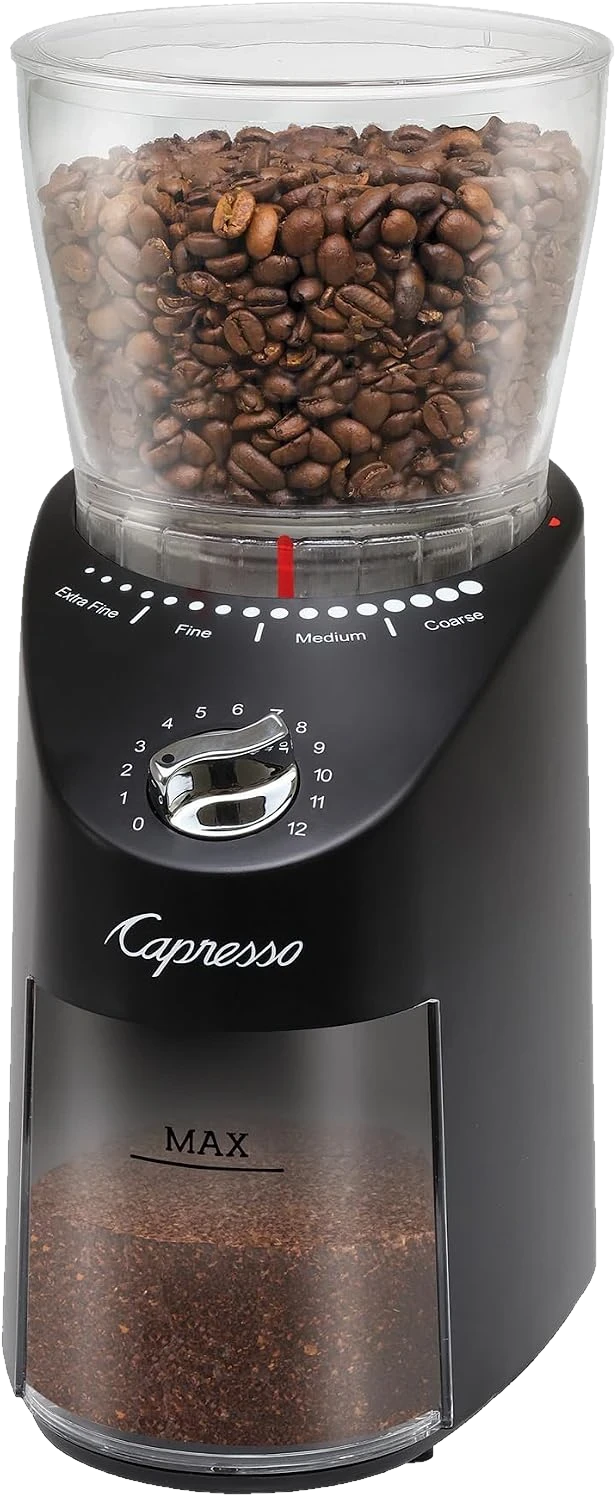
The Capresso Infinity Plus punches well above its price. The secret is the Swiss-made conical steel burrs — cut to 0.1mm precision, produced as matched pairs and hand-assembled in Switzerland. That's the kind of manufacturing you'd expect from a grinder costing far more than $100. The gear reduction motor turns the burrs at under 450 rpm, which means less friction, less heat, and more preserved flavor and aroma. It's noticeably quieter than most grinders at this price too. The 16 settings are organized into four clear categories (extra fine, fine, regular, coarse), which makes it approachable for beginners who don't want to guess. It can grind fine enough for Turkish coffee — a rare feature at any price. The build quality isn't going to rival a Baratza, but for $100, the grind quality is remarkable.

Pros

  • Steel conical burrs cut to 0.1mm, hand-assembled in Switzerland
  • Slowest grinding speed in class — preserves flavor and aroma
  • Noticeably quiet operation
  • Can grind fine enough for Turkish coffee
  • Clear 4-category setting organization for beginners

Cons

  • 16 settings is fewer steps than competitors with 30-60
  • Plastic body feels budget at the price
  • 4oz grounds container is small for batch grinding
  • Timer dial is less precise than digital controls
Best Ultra-Budget
Burrs
Flat
Settings
18
Espresso
Filter only
Holds
8 oz

Why we love it

Let's be honest: if you're coming from a blade grinder (or pre-ground coffee), the Cuisinart DBM-8 is the cheapest meaningful upgrade you can make. It's the default first burr grinder for a reason — 18 grind positions from ultra-fine to extra-coarse, a slide-dial selector that couldn't be simpler, and a cup-size selector from 4 to 18 cups so you grind exactly what you need. The flat burr design produces reasonably uniform grounds for drip, pour over, and French press. Will it match a premium burr grinder? No. The grind consistency isn't as tight, and it's louder and messier than pricier options. But at under $75, it's a legitimate burr grinder that makes a real difference in your coffee compared to blade grinding or buying pre-ground. If you're testing whether fresh-ground coffee is worth it before investing more, start here.

Pros

  • Under $75 — cheapest real burr grinder worth buying
  • Dead-simple slide-dial and cup-size selector
  • 18 grind positions cover most brew methods
  • Large hopper holds 8oz of beans

Cons

  • Flat burrs produce more inconsistency than conical at this price
  • Noticeably loud during grinding
  • Static causes grounds to cling — expect some mess
  • Not suitable for espresso despite having fine settings
Timer to a Tenth of a Second
Burrs
40 mm conical
Settings
51
Espresso
Yes
Width
4.9 in

Why we love it

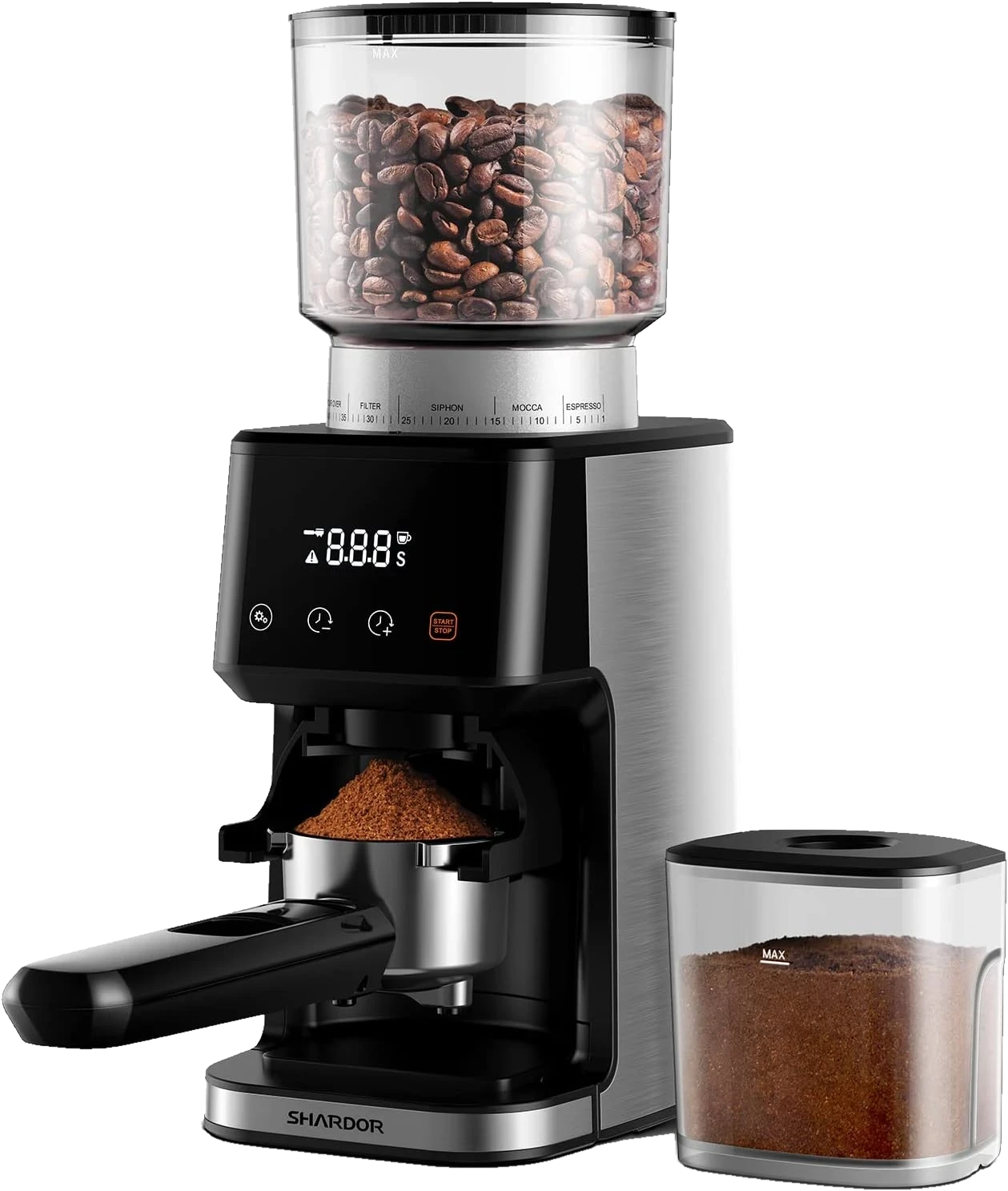
At around $65, the SHARDOR sits in interesting territory: it's a budget grinder, but not a throwaway one. It earns that price with 51 grind settings, a touchscreen precision timer so you get the same dose every morning without a scale, and anti-static technology that keeps your counter clean. The grind consistency isn't Baratza-level, but it's genuinely good enough that you'll taste the difference vs. pre-ground or blade-ground coffee from day one. If you want to find out whether freshly ground coffee is worth caring about before spending more, this is the grinder to start with.

Pros

  • 51 grind settings, from espresso to French press
  • Precision timer touchscreen for consistent dosing without a scale
  • Anti-static design reduces mess
  • Real burr grinding at a blade-grinder budget
  • Compact and lightweight

Cons

  • Grind consistency is noticeably behind pricier grinders
  • Espresso results are inconsistent — better for drip and pour over
  • Plastic construction won't last as long as metal alternatives
  • Some owners can't get it fine enough for espresso
  • Louder motor than premium options
  • Some owners report it failing within months

Room for a little more?

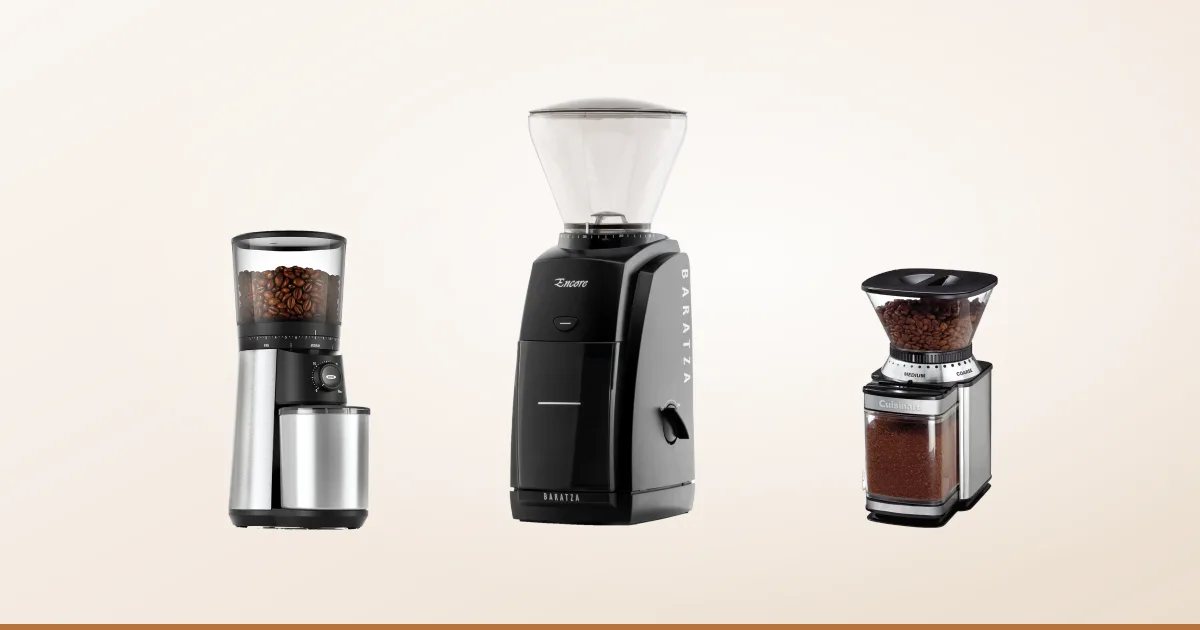
The Baratza Encore at $150 has 40 settings and replacement parts Baratza sells for years, so a worn part is a repair rather than a new grinder. It’s over this budget, and it heads the best grinders for drip coffee.

How we chose these

Grind evenness first, judged on the burr: conical or flat, its size where the maker states it, and how much fine dust it makes. Then the daily routine at each end: for a hand grinder, how easily it turns and whether you can find a setting again; for an electric, how it doses a pot, by timer, cup count or one button, and how loud it runs. Then how long it lasts, including what owners report about early failures. Every spec is the maker’s own, and one it doesn’t publish is left off. Prices come from Amazon and are updated regularly; the current price is always on Amazon. Every pick is under $100 at those prices.

What to know before you buy

What’s the best coffee grinder under $100?

By hand, the Timemore Chestnut C3S at $65. With a motor, the OXO Brew Conical Burr at $80. The C3S’s S2C conical burr makes little fine dust, a built-in bearing keeps the handle turning, and its aluminum body has no plastic shell to crack; for one or two cups it is the more even grind of the two. The OXO runs 40mm stainless conical burrs with 15 settings plus micro-adjustments, a 12 oz hopper and a one-touch start that remembers your last setting, so a full pot is one press. Some OXO owners report it breaking down within months.

What’s the best coffee grinder under $50?

None of the burr grinders here is under $50, and it’s worth stretching to one. Under $50 the electrics are mostly blade grinders, which chop beans into dust and chunks that brew at different speeds, so a cup comes out bitter and sour at once. The cheap burr grinders at that price are mostly hand grinders whose shafts wobble enough to undo the point of a burr. The two to stretch to are the Cuisinart Supreme Grind, an electric with flat burrs that doses a pot by cup count, and the 1Zpresso Q Air, a hand grinder with a stainless conical burr and numbered clicks. If $50 is the limit, a blade grinder does least harm in a French press, where the coarse grind and the mesh forgive uneven pieces.

Should I buy a hand or electric grinder under $100?

Count the cups. For one or two a morning, a hand grinder: under $100 it grinds more evenly than an electric that costs the same, and a filter dose is thirty to sixty seconds of turning. For a full pot, or for more than one person, an electric: a pot by hand is several doses of turning before work, which is the routine people stop keeping. A hand grinder also travels, and the 1Zpresso Q Air nests inside an AeroPress plunger.

What’s the best coffee grinder under $100 for espresso?

Nothing here is an espresso grinder. Dialing in a shot takes fine steps in a narrow range, and these spread their settings from fine to French press. The SHARDOR is the one to try on a machine with pressurized baskets, which build pressure themselves and forgive the grind: 51 settings from espresso fine, a timer in 0.1-second steps and a cradle that holds a portafilter under the chute. Some owners can’t get it fine enough. For a machine with unpressurized baskets, our espresso grinder guide has grinders built for it.

OXO Brew or Capresso Infinity Plus?

The OXO for a pot with the least work, the Capresso for a quieter grinder with a wider range. The OXO has 15 settings plus micro-adjustments, a 12 oz hopper and a one-touch start that remembers your setting. The Capresso turns its steel conical burrs on a low-speed gear motor, under 450 rpm, which keeps it quiet, and its 16 settings run from Turkish fine to cold brew coarse. Its timer is a dial rather than a button, and its grounds container holds 4 oz.

Is the SHARDOR coffee grinder any good?

It has more controls than any other electric here: 51 settings, a touchscreen timer up to 60 seconds in 0.1-second steps, a selector for 1 to 12 cups, a portafilter cradle and 40mm stainless conical burrs. Lasting is the question. Some owners report it failing within months, and its grind is less even than pricier grinders. Buy it for the timer and the cradle. For a grinder you can repair rather than replace, the Baratza Encore sells parts for years, over this budget.

Bottom line

Buy the Timemore Chestnut C3S at $65 for the most even grind under $100, a cup or two at a time by hand. Take the 1Zpresso Q Air instead if the grinder travels with you. For a full pot, buy the OXO Brew: one press every morning and 12 oz of beans in the hopper. The Capresso Infinity Plus is the quiet electric, and the Cuisinart Supreme Grind doses the pot by cup count.

Related guides

Stay in the loop

New gear reviews, brew tips, and the occasional deal — straight to your inbox. No spam, ever.

Just your email, nothing else. Privacy