One machine refuses to have settings. The other has six brew modes and a screen. Both are SCA certified, and that's most of what they agree on.
The Breville wins more rows here and is still not our pick. Four of its wins are modes and capacity most households never use, and the two the Moccamaster takes — price and warranty — apply every day it sits on the counter.
The difference that actually matters
Both machines hold 196–205°F through the brew, which is the single thing that separates good drip coffee from bad. They get there by opposite routes: a copper element sized so it can only produce that range, versus a thermocoil and a PID controller that can produce any range and is told to produce that one.
That difference has nothing to do with the coffee and everything to do with what you own afterwards. The Moccamaster can’t be set wrong because there is nothing to set. The Breville can be set to 185°F and a slow flow, which will under-extract a dark roast into something flat — and can also be set to bloom a light Ethiopian for 45 seconds and pull flavours the Moccamaster leaves in the grounds.
So the real question isn’t which is better. It’s whether you want a machine with a ceiling you can’t raise, or a floor you can fall through. Neither answer is wrong, and they cost $100 apart.
If you’re asking about plastic
Neither has a plastic-free brew path. Both run brew-temperature water through plastic components, and both use BPA-free plastics, which describes what is absent rather than what is present. If that’s the deciding factor, see plastic-free coffee makers for what actually qualifies.
Is the Breville Precision Brewer better than the Moccamaster?
At their default settings, brewing the same beans, no — they’re close enough that a blind cup wouldn’t separate them reliably. Both hold the 196–205°F window that SCA certification requires, and that window is most of what determines a good drip cup. The Breville is better at being several machines: it brews over ice, runs a cold brew cycle, takes a pour-over cone, and lets you move temperature, bloom and flow rate independently. The Moccamaster is better at being one machine forever. Ask which job you’re buying for, because "better" doesn’t resolve without it.
Is the Breville worth $100 more than the Moccamaster?
Only if you’ll use the modes. The honest test is whether you currently make iced coffee, cold brew, or pour over by some other method — if you do, the Breville replaces two or three pieces of gear and $100 is cheap. If you make a pot of hot coffee every morning and nothing else, you’d be paying $455 for five modes you’ll never open, and the Moccamaster does the sixth one better for less.
What’s the difference between the Moccamaster and the Breville Precision Brewer?
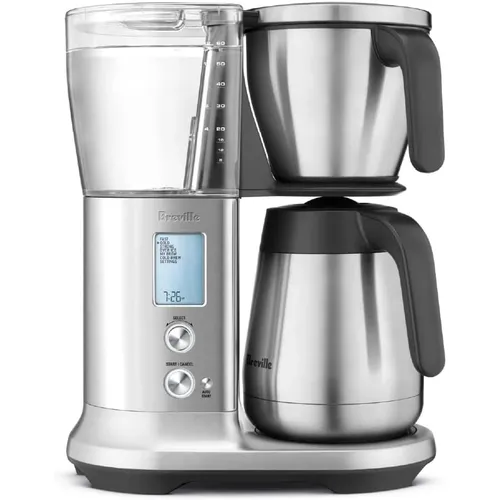
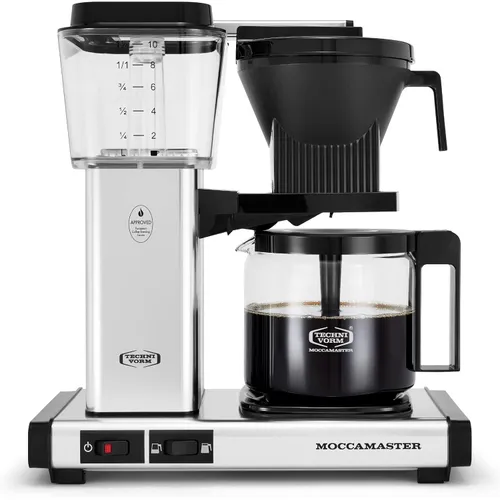
Both hold 196–205°F through the brew, which is the thing SCA certification tests and most of what separates good drip from bad. Everything else differs. The Moccamaster has one mode and two controls; the Breville has six modes, an adjustable 185–205°F range, and separate control over bloom and flow rate. The Breville’s carafe is 60oz and thermal against the Moccamaster’s 40oz glass on a hotplate, and it ships a pour-over cone adapter. The Moccamaster is hand-assembled with a five-year warranty and lifetime repairs; the Breville carries two years and more electronics to fail.
Which has the better carafe, the Moccamaster or the Breville?
The Breville, and it isn’t close for most households. It’s 60oz and thermal, so the coffee sits at temperature without cooking. The Moccamaster KBGV is 40oz glass on a hotplate, and a hotplate keeps coffee hot by continuing to brew it — a pot that sits an hour tastes noticeably worse than it did at minute five. If your household drinks the pot inside 20 minutes the glass is easier to clean and perfectly fine. Technivorm does sell a thermal version, the KBGT, if you want the Moccamaster build with a thermal carafe.
Which lasts longer, the Moccamaster or the Breville?
The Moccamaster, on the evidence available. Five-year warranty against two, hand-assembled in the Netherlands, and every part is user-replaceable — people run fifteen-year-old units on replacement elements. The Breville has more to go wrong by design: a PID controller, a screen, a valve, and six modes of firmware. That’s the cost of doing more things, not a defect, but it’s a real difference over a decade.
Does the Moccamaster or the Breville Precision Brewer make cold brew?
The Breville does and the Moccamaster does not — and it is the Breville mode we’d weigh least. It’s a long cold cycle rather than true immersion steeping, and a $25 jar left overnight gets you a comparable result. Treat the cold brew setting as a bonus rather than a reason to buy — the modes worth paying for are Gold Cup, Over Ice, and My Brew.
Moccamaster or Breville for a small kitchen?
The Moccamaster. It’s tall and narrow, so it takes vertical space rather than counter. The Breville is wide, weighs about 10 lbs, and needs clearance for the brew basket and the lid, and its reservoir is fixed to the machine so you’re filling it in place or carrying the whole unit to the tap. In a tight kitchen that’s a daily annoyance rather than a spec-sheet footnote.