GuidesComparisons
Roundup

Best Grind-and-Brew Coffee Makers

Five machines that grind the beans and brew them in one go — and the one specification that decides whether it was worth it.

By Dana WhitfieldUpdated September 2026
5 products compared9 min read

A grind-and-brew is one machine that does the job of two: beans go in a hopper, ground coffee lands in the basket, and the pot fills without you touching anything. The appeal is obvious, and so is the catch — you are buying a grinder you cannot upgrade, service or replace on its own, bolted to a brewer you would have bought anyway.

Whether that trade is worth it comes down to one specification, and it is the one manufacturers are vaguest about: is the grinder a burr or a blade. A blade chops beans into dust and boulders in the same pass. The dust over-extracts and turns bitter while the boulders barely extract at all, which is why cheap grind-and-brew coffee manages to taste burnt and weak at once. Every machine on this page uses a burr.

Picks are sorted by what the machine is actually for rather than by price, because the real fork here is whether you brew cups or pots. A machine that only makes a full carafe is a different purchase from one that grinds a single dose into a travel mug, and the price tells you almost nothing about which you are getting.

Quick picks

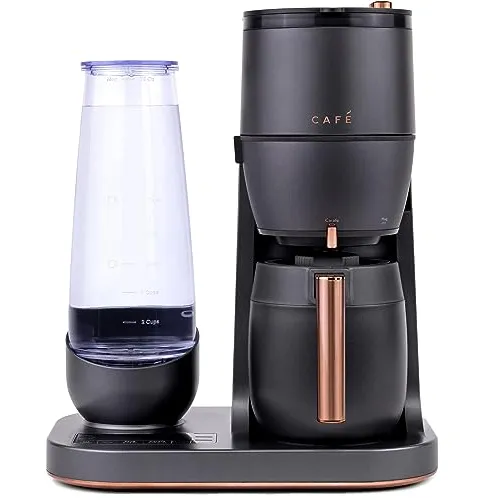
Café Specialty Grind and Brew

Café Specialty Grind and Brew

$328

SCA-certified ten-cup brewer with an adjustable burr grinder, double-walled vacuum carafe, removable reservoir, and app or voice control.

Jump to review
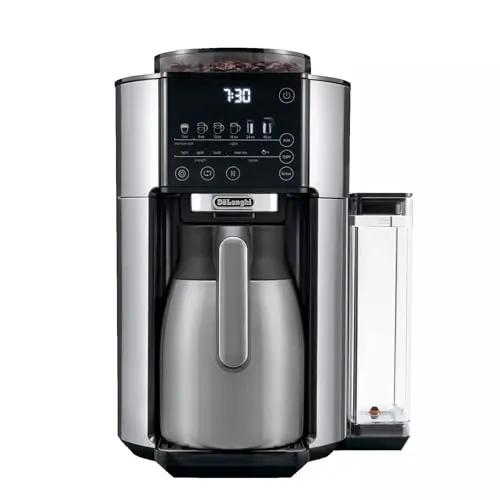
De'Longhi TrueBrew CAM51035M

De'Longhi TrueBrew CAM51035M

$450

Bean-to-cup drip machine with a conical burr grinder, six brew sizes from a single cup to a carafe, and five styles including an over-ice setting.

Jump to review
Breville Grind Control

Breville Grind Control

$400

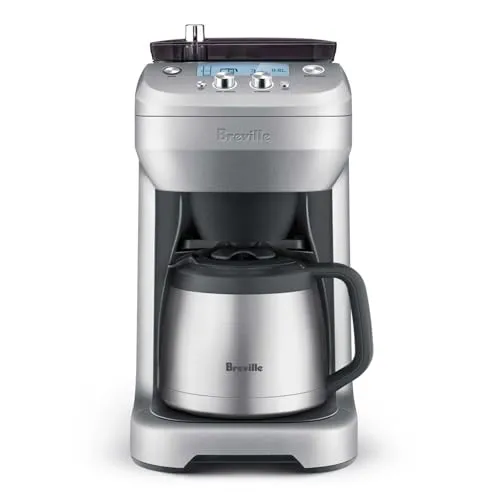
Twelve-cup grind-and-brew with a stainless thermal carafe, eight strength settings, a half-pound bean hopper, and the option to brew straight into a travel mug.

Jump to review

Best overall

The only machine here that is SCA certified and states, in writing, that its grinder is a burr. Everything else on this page asks you to take one of those on trust.

Café Specialty Grind and Brew

Café

Café Specialty Grind and Brew

$328.00
9/ 10
Check price on Amazon

Why we love it

This is the rare grind-and-brew that carries SCA certification, which means the brew temperature and contact time were measured rather than claimed. The grinder is stated as an adjustable burr with six settings, the carafe is double-walled vacuum rather than a hotplate, and the reservoir lifts out to fill at the sink. It also brews a single cup straight into a travel mug, so bean-to-cup doesn't have to mean a whole pot.

Pros

  • SCA certified — brew temperature and contact time verified, not claimed
  • Adjustable burr grinder, stated as such, with six settings
  • Double-walled vacuum carafe holds heat without cooking the coffee
  • Removable reservoir you can fill at the sink
  • Single-serve straight into a travel mug, no pods

Cons

  • Wi-Fi and app control are the headline feature and not everyone wants them
  • Six grind settings is fewer than a dedicated grinder gives you
  • Carbon water filter is a recurring replacement
  • Large footprint

If you brew cups more often than pots

Grinding per cup is the whole point of a machine like this, and these two are built for it rather than treating a single mug as a small pot.

De'Longhi TrueBrew CAM51035M

De'Longhi

De'Longhi TrueBrew CAM51035M

$449.99
8.8/ 10
Check price on Amazon

Why we love it

This is the grind-and-brew that doesn't make you choose between a single cup and a pot. Six sizes run from an 8 oz cup to a 40 oz carafe, and a 3 oz espresso-style pour sits at the other end. De'Longhi states a conical burr rather than leaving the grinder type vague, which most machines in this class do. The over-ice style brews stronger to survive dilution instead of just brewing hot coffee onto cubes.

Pros

  • Conical burr grinder, stated as such by the manufacturer
  • Six brew sizes — single cup through a full carafe
  • Over-ice style brews for dilution rather than pouring hot coffee on ice
  • Grinds, doses and brews per cup rather than per pot

Cons

  • The most expensive grind-and-brew here by a clear margin
  • Large footprint — measure before you commit to it
  • Sold in several near-identical variants, so check the model code
  • More machine than someone who only ever brews a full pot needs
Breville Grind Control

Breville

Breville Grind Control

$399.95
8.5/ 10
Check price on Amazon

Why we love it

The Grind Control brews into a carafe, a tall cup or a travel mug without an adapter, which is the practical difference between a machine one person uses and a machine a household uses. Eight strength settings and an adjustable grind give it more range than the single dial most grind-and-brews offer, and a pre-ground option means a bag of decaf doesn't strand the machine. Worth noting: Breville calls it an adjustable integrated grinder and doesn't state the burr type in the listing.

Pros

  • Brews into a carafe, tall cup or travel mug with no adapter
  • Eight strength settings plus adjustable grind size
  • Dual-wall stainless thermal carafe — no hotplate
  • Pre-ground option for when you don't want to use the hopper
  • Half-pound bean hopper

Cons

  • Breville doesn't state the grinder's burr type in the listing
  • One-year warranty, short for the price
  • Large footprint
  • Grinder adds noise and parts to clean compared with a plain brewer

Spending less

Both have a real burr grinder, which is the specification worth protecting at this price. What you give up is the thermal carafe — both sit a glass pot on a hotplate.

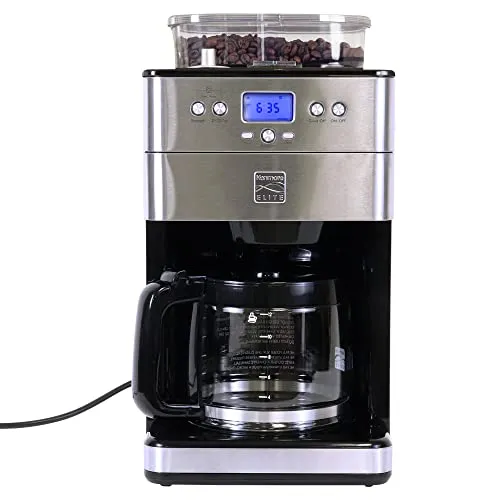
Kenmore Elite Grind and Brew

Kenmore

Kenmore Elite Grind and Brew

$261.22
8/ 10
Check price on Amazon

Why we love it

A burr grinder with an actual grind size selector is the thing to look for at this price, and this has one — most machines near it use a blade and call it a grinder. You pick 2, 4, 6, 8, 10 or 12 cups and it grinds only that much, so a single mug doesn't cost you a hopper's worth of beans. The hopper seals, which matters more than it sounds when beans sit in it for a week.

Pros

  • Burr grinder with a grind size selector, not a blade
  • Grinds only what the selected cup count needs
  • Airtight half-pound hopper keeps beans from staling
  • Grind-off mode for pre-ground coffee
  • Built-in charcoal water filter

Cons

  • Sold under the Kenmore name by a licensee, so support is a step removed
  • Glass carafe on a hotplate — it will cook the coffee if you leave it
  • Three strength settings only — mild, medium, strong
  • Less established in coffee than the brands around it
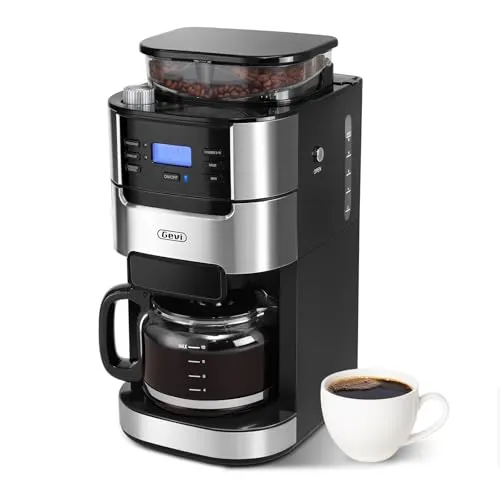
Gevi 10-Cup Grind & Brew

Gevi

Gevi 10-Cup Grind & Brew

$139.99
7.6/ 10
Check price on Amazon

Why we love it

The cheapest way into a genuine burr grind-and-brew. Eight grind settings and a pre-brew bloom are specifications you normally have to pay a lot more for, and a 2-cup mode adjusts the water-to-coffee ratio instead of just brewing less. It's the budget pick rather than the good-for-the-money pick — but the grinder is a burr, which is the part that actually decides how the coffee tastes.

Pros

  • Built-in burr grinder at the bottom of the category's price range
  • Eight grind settings and three strength levels
  • Pre-brew bloom, usually a feature of far pricier machines
  • Two-cup mode adjusts the ratio rather than just brewing less
  • Reusable filter included

Cons

  • Gevi lists several near-identical models, so the exact one can change under you
  • Tall — check cabinet clearance before buying
  • Less established than the brands above it, with a shorter track record
  • Glass carafe on a hotplate, not thermal

Burr or blade is the whole question

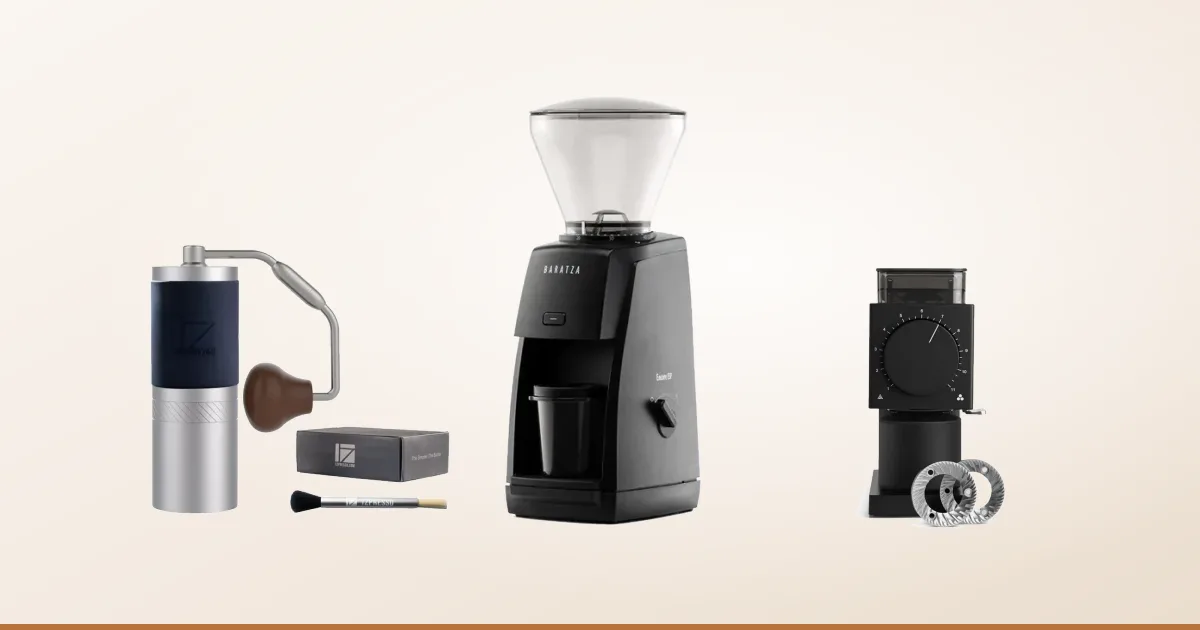
A blade grinder chops beans into a mix of dust and boulders, and dust over-extracts while boulders barely extract at all — which is why cheap grind-and-brew machines make coffee that is bitter and weak at the same time. Every machine on this page uses a burr. If you are looking at one that doesn't say, assume it's a blade. A separate burr grinder and a plain brewer will beat any of these, and costs less than the two at the top — the trade you are buying here is one machine and one button instead of two.

How we chose these

Burr grinders only — a blade in a grind-and-brew undoes the reason for buying one. Machines that state the burr type in writing were ranked above those that describe an “integrated grinder” and leave it there, and where a manufacturer won’t say, the page says so rather than assuming. SCA certification counted heavily, because it is the only claim here that was measured by somebody other than the seller. Thermal carafes were preferred over hotplates, and grind-off modes counted in a machine’s favour: a bag of decaf or a pre-ground gift shouldn’t strand the machine.

What to know before you buy

What’s the best grind and brew coffee maker?

The Café Specialty Grind and Brew at $328. It is the only machine on this page that is SCA certified — meaning its brew temperature and contact time were measured rather than claimed — and the only one whose listing states plainly that the grinder is an adjustable burr with six settings. It also has a double-walled vacuum carafe instead of a hotplate, a removable reservoir you can fill at the sink, and a single-serve mode that brews straight into a travel mug. Everything else here asks you to take at least one of those on trust.

Are grind and brew coffee makers worth it?

Only if you want one machine and one button. A separate burr grinder and a plain brewer will make better coffee than any all-in-one, cost less than the two machines at the top of this page, and let you replace either half when it fails or when you outgrow it. What a grind-and-brew buys is counter space and a morning with one less step in it. That is a real thing to want — it just isn’t a coffee upgrade, and a machine that gets used every day beats a better setup that feels like work.

Is a burr grinder necessary in a grind and brew?

Yes, and it is the only specification on the box worth insisting on. A burr crushes beans between two surfaces set a fixed distance apart, so the grounds come out roughly one size. A blade spins and chops, producing dust and boulders together, and no brewer can fix that afterwards — the dust over-extracts into bitterness while the boulders pass through barely touched. If a listing says “grinder” without saying “burr”, assume blade. Manufacturers say burr when they have one.

Can you use pre-ground coffee in a grind and brew?

On every machine here, yes — look for a grind-off or pre-ground setting, which bypasses the hopper and lets you fill the basket yourself. It matters more than it sounds. Without it, a bag of decaf, a gift of pre-ground coffee, or a grinder that jams leaves you with a machine you can’t use. The Kenmore and the Breville both make this a labelled button rather than a menu item buried three presses deep.

What’s the best grind and brew with a thermal carafe?

The Café Specialty at $328, whose carafe is double-walled vacuum, or the Breville Grind Control at $400 if you want to brew into a travel mug as easily as into the pot. This is the single upgrade most worth paying for on a machine that grinds fresh: a hotplate holds coffee hot by continuing to cook it, so the second cup undoes the work the grinder just did. Both budget machines here sit a glass pot on a warming plate, which is the main thing you give up by spending less.

Do grind and brew machines get clogged?

Ground coffee is oily and it builds up in the chute between the grinder and the basket, which is the part you cannot see and the failure that kills these machines. Dark and oily roasts make it worse and faster. Plan on brushing the chute out every few weeks, buy beans that aren’t glossy with oil, and treat a machine whose grinder assembly doesn’t come apart for cleaning as a machine with an expiry date. This is the honest downside of an all-in-one: when the grinder half goes, you replace the brewer half too.

What’s the cheapest grind and brew worth buying?

The Gevi 10-Cup at $140, and it clears the bar for one reason: the grinder is a burr. It also has eight grind settings and a pre-brew bloom, which are specifications you normally pay considerably more for. The compromises are real — a glass carafe on a hotplate, a shorter track record than the established brands, and a family of near-identical models that makes it hard to be sure which one you are ordering. Check the model against the listing before you buy.

Bottom line

Buy the Café Specialty Grind and Brew at $328. It is the only machine here with SCA certification and a stated burr grinder, and its vacuum carafe means the pot is still worth pouring an hour later. If you mostly brew single cups, the De’Longhi TrueBrew at $450 grinds per cup across six sizes and brews over ice properly. If the budget is the constraint, the Gevi at $140 keeps the burr and gives up the thermal carafe. And if none of this appeals, a separate grinder and a plain brewer will beat all of them — that is a fair conclusion to reach on this page.

Related guides

Stay in the loop

New gear reviews, brew tips, and the occasional deal — straight to your inbox. No spam, ever.